


News, views and directions from the European left
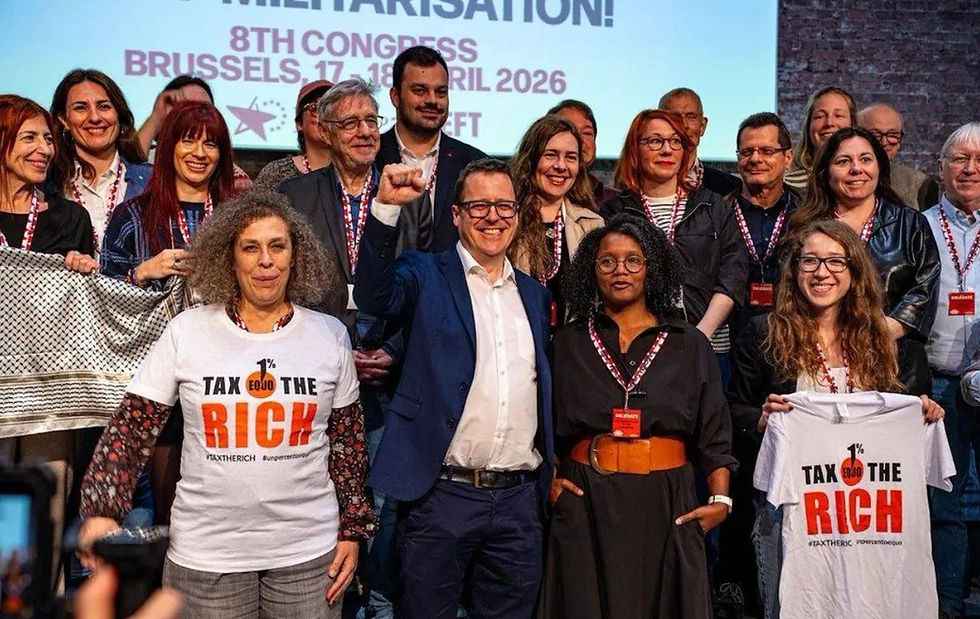
Doug Chalmers reports on this month’s Congress of the European Left Party, which he attended as a representative of Democratic Left Scotland.
How to build a new democratic socialist society – feminist and ecologically sustainable, in a time of austerity and militarism?
That was the background question to the 8th Congress of the Party of the European Left.
Founded in 2004, the Party of the European Left consists of 22 member parties, ranging from the PCF, die Linke, Syriza, Izquierda Unida, United Left of Catalonia, the PCE, and communist or former communist parties from many other European countries. It also has ten partner associations or parties, including Democratic Left Scotland and - also from Scotland - Socialists for Independence, and finally also seven observer parties, such as AKEL from Cyprus.
It has a tremendous research organisation Transform Europe, which works closely with the Rosa Luxembourg foundation, and also a women's wing named EL-Fem – accessible for women via Facebook.
Until a few years ago, it also included other parties of the European Left, but these now organise under another centre, whilst still collaborating in the European Parliament. An interesting point of view on why the two parties diverged can be found is explored in this article (click the link). I’m not yet expert enough to assess these differences myself yet.
Over two days the Congress, held in Brussels, debated and discussed resolutions on many topics including the aggression against Iran, housing, the digital economy, the self-determination of Cuba and of Greenland, Palestine, the situation of Cyprus, Asylum and Human Rights, and also the adoption of a general position paper entitled Win the future, fight austerity, and stop militarisation. This latter was eventually overwhelmingly adopted in a free vote after a series of interventions and amendments - which nevertheless displayed some of the general differences that exist amongst the left in Europe.
However, it was good to see agreement reached on a whole range of issues that not only affect those living in the EU but also wider Europe and beyond. There was concern about the willingness of ruling parties of the right to move for alliances with the far right to deal with the growing instability in today’s Europe. Congress came out firmly against the ‘century of rearmament’ currently being pushed by NATO and promoted by the European Commission under Ursula von der Leyen and their call for Europe to ‘speak the language of power’.
Although it’s difficult to summarise the general fault lines that still exist in such a broad endeavour as forging unity amongst Left parties, throughout the European continent, there is clearly still a tension as to how the Russia-Ukraine conflict should be understood and categorised and on the future role of Nato. While Russia’s invasion was condemned as a clear violation of international law, there was a general consensus that what we were currently seeing was a proxy war between Nato and Russia, with its roots arising in the period before the conflict broke into open warfare.
There are clearly also different views as to whether Nato should have a future role at all in Europe – the predominant view being that Nato should be abolished and instead a new security architecture instigated with Europe demilitarised rather than re-militarised. There was an agreement that what was needed was collective security - what was called a ‘Helsinki 2.0’ approach - and a revitalisation of the Organisation for Security and Cooperation in Europe (OSCE). There was renewed agreement that there should also be closure of all foreign military bases on European soil.
Although this was the position which was adopted by the European Left Party, it was also clear that some member parties wished the emphasis to be more towards separating European policy making from Nato, rather than its abolition.
Throughout Congress there was a constant emphasis on the positive role of feminism – the PCE delegates in particular highlighting this – ‘Feminism is one of the strongest sources of hope and inspiration in the struggle for a new society’, with gender-based violence being seen as a ‘structural emergency’. In relation to Feminism, Antifascism and War, there was a demand that there should be a ‘permanent feminist presence at all Peace negotiations’
It was also evident from discussions that the housing crisis - for young people particularly - has been and is an ongoing area of campaigning throughout Europe by those on the Left.
On sustainable economies there was a pledge of support for sustainable, local, circular economies and the concept of the ’15-minute city’.
On culture, the slogan was ‘Culture costs. No culture costs more’, and they called for a reset of UK-EU cultural exchanges - especially in the area of young people’s activity.
On the subject of the world economic system, Congress acknowledged the formation of the BRICS as an example of an emerging multipolar world - which delegates felt, however, was not inevitable.
This was an area where I personally thought more needed to be done and expressed. I certainly think more emphasis and consideration needs made of the move towards multipolarity and the dying of the old Empires as a guide to understanding current change.
On Europe itself, Congress delegates called for a ‘pressing of the reset button’ away from the interest of big capital. They also acknowledge that the EU is not synonymous with Europe, and will not be in the near future. They rejected ‘enlargement as a geopolitical weapon in great power rivalries’ and rather, wanted this to reflect only a ‘Europe of solidarity, cooperation and peace’. As a current example, they referred to the case of Ukraine as being one where ‘rare earth materials, agricultural exploitation and NATO integration drive the agenda rather than genuine solidarity with the Ukrainian people’.
On migration, Congress recognised that the main drivers are fleeing from misery and oppression, but also identified migration as a centuries old driver of renewed human encounters and positive development. There was a call for a break from the ‘fortress Europe’ approach and stood firmly for the human right to asylum as well as legal and safe pathways for migration. Delegates argued for the adoption of a migration approach with a ‘comprehensive gender perspective’ which would follow feminist principles aimed at protection not exclusion.
An interesting video of some of the extracts from Congress including extracts from a public event on fighting austerity and militarisation can be viewed by clicking here. This features guest speeches from Jeremy Corbyn, Megan Romer, the co-chair of the 105 thousand strong Democratic Socialists of America, Amal Jadou Shakaa, the Palestinian ambassador to the EU, Janina Böttger, chair of die Linke in Saxony Anhalt, Germany, Fabien Russell, National Secretary of the PCF and others. Other guests – not featured here, were representatives of the Cuban, Japanese and Chinese Communist Parties.
Published 27 April 2026


